Using Wireless Sensors To Measure The Water Temperature Profile Of A Lake
INTRODUCTION
The water temperature profile of a lake (variation of temperature with depth) is affected by many factors such as seasonal, area and depth of water, surrounding geography and climate and weather conditions. As this has an effect on the aquatic life, knowing the water temperature profile at various points in time is very important in ecological studies.
The usual temperature measurement methods vary from using imprecise and laborious manual procedures – a thermometer tied to a rope or water buckets, to using electronic underwater temperature sensors or instrumentation buoys with various degrees of complexity and flexibility, and usually a higher cost.
Here is presented a scalable, cost-efficient and accurate solution to measure the water temperature profile of a lake by using wireless sensors.
Deer Lake, located in central Burnaby, BC, has been selected for this project.
WIRELESS SENSOR SYSTEM DESCRIPTION
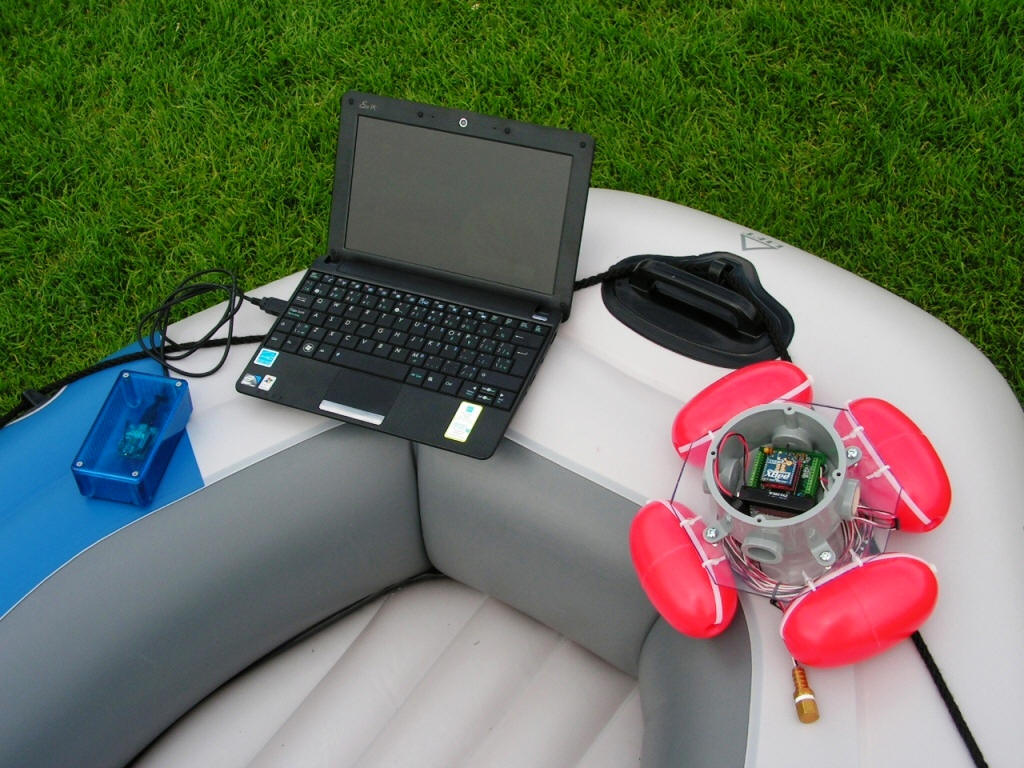
The measurement system developed and used for this project consists of a sensor node (mote) installed on a small buoy anchored at a selected location on the lake, and a base station located on-board of a small boat that was kept within the wireless communication range with the mote.
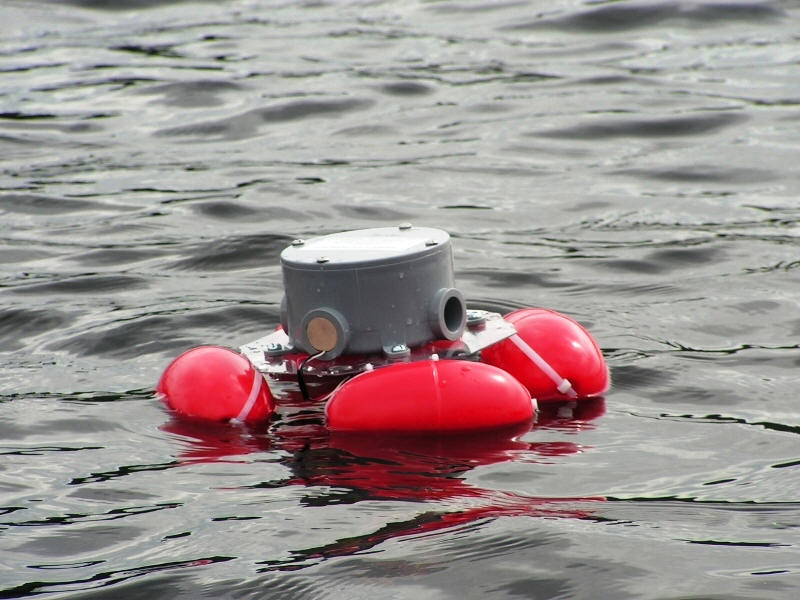
The wireless communication range between the mote and the base station depends on the RF power used, and is typically from 100m to 3km.
The mote is a small electronic module measuring 2"x2", powered by two AA batteries and equipped with up to 7 underwater temperature probes. The batteries can last for several years depending on the configurable sleep-awake cycle. The temperature probes are installed on a cable and submerged at the desired depths. All probes are simultaneously sampled during the awake state and the acquired temperature data is sent to the base station. The temperature probes are using semiconductor technology and can be calibrated in software to the required accuracy.
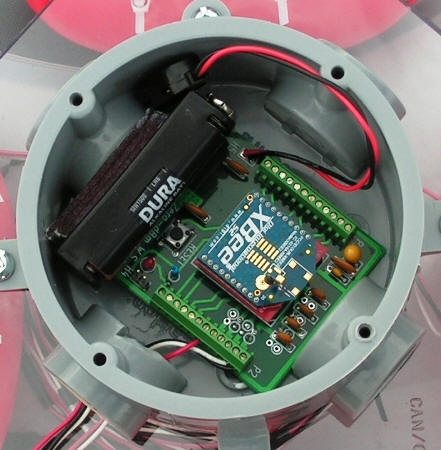
The base station contains an electronic module similar to that of the mote and for this project it was connected directly to a laptop computer through a USB cable for local data collection. A custom software application was developed to decode the data packets received from the mote and store the temperature data to a file on the laptop's hard drive.
The communication protocol used in the mote and base station is based on the ZigBee standard. This makes the system easily expandable into a wireless sensor network (WSN) by installing additional motes, which are automatically acknowledged by the base station.
For long term monitoring, the base station can be connected to a gateway (wifi, cellular modem) and placed on the shore of the lake, such as in a tree, to transmit the measurement data in real time to a remote location (office).
The system can be easily customized to meet the requirements of any specific application by changing its architecture, enclosures and software, or by adding other type of sensors such as pressure, light, pH, oxygen.
PHYSICAL CHARACTERISTICS OF DEER LAKE
Deer Lake has an area of 86 acres, a mean depth of 3.2m and a maximum depth of 6.4m (per BC Ministry of Environment bathymetric maps). It is surrounded by low park land with a good exposure to winds.
MEASUREMENT DATA
The objective was to get a snapshot of the water column temperature in the middle of the lake.
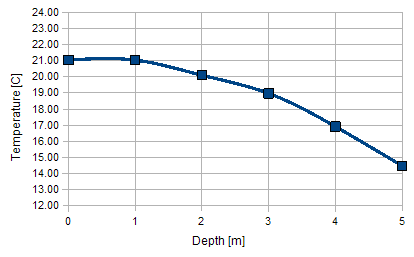
The temperature was measured from the surface to the bottom of the lake at intervals of 1m. The 0m depth was just below the water surface at about 10cm. The air temperature was measured close to the water surface and shielded from the sun's radiation.
The temperature probes were calibrated against a NIST traceable standard thermometer. Multiple readings were taken at each depth level to ensure that the temperature probes have stabilized.
Conditions at measurement time:

Measurement data (temperature vs. depth level):

Interpretation of the measurement data is beyond the scope of this report.
SUMMARY
A scalable, cost-efficient and accurate solution to measure the water temperature profile of a lake, or any other body of water, was presented. The system is easily expandable into a network of sensor nodes by just adding additional motes across the monitored area and can be configured for either snapshot measurements or long time monitoring.